
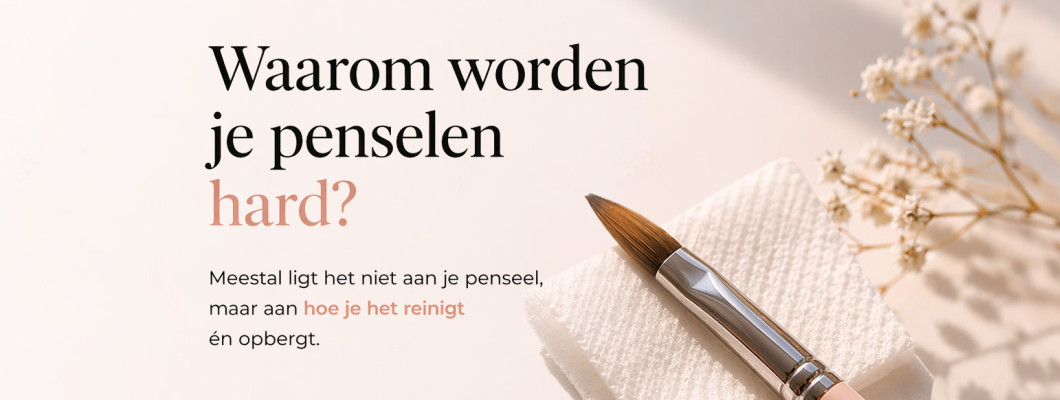
Het is een veelvoorkomend probleem in de nagelwereld: penselen die na enkele behandelingen hard worden en onbruikbaar lijken. Vaak worden ze dan gezien als “versleten”, terwijl de echte oorzaak meestal ligt bij een fout in het onderhoud.
In deze blog ontdek je hoe je nagelpenselen correct reinigt en onderhoudt, zodat ze niet verharden en jarenlang meegaan.
Waarom worden nagelpenselen hard?
Nagelpenselen worden hard door uitgeharde productresten die in de haren achterblijven.
Wanneer gel, acrygel of andere systemen niet volledig verwijderd worden, kunnen ze:
- uitharden door UV/LED-licht
- reageren met lucht en temperatuur
- zich opstapelen in de kern van het penseel
Dit zorgt ervoor dat de haren verstijven en hun flexibiliteit verliezen.
De grootste fouten bij het reinigen van penselen
1. Cleanser of remover gebruiken
Veel nail techs reinigen hun penseel met cleanser of remover, maar dit is een van de grootste fouten.
Deze producten:
- tasten de structuur van de haren aan
- duwen product dieper in het penseel
- versnellen het uithardingsproces
2. Penseel opbergen met productresten
Zelfs kleine restjes gel kunnen voldoende zijn om je penseel hard te maken. Zeker bij builder gels en dikkere systemen is dit een groot risico.
3. Geen droge reiniging toepassen
Een correcte droge reiniging wordt vaak onderschat.
Nochtans is dit de meest veilige en effectieve manier om productresten te verwijderen zonder schade.
Hoe nagelpenselen correct reinigen (professionele methode)
Wil je de levensduur van je penselen maximaliseren? Volg dan deze werkwijze:
- Gebruik een droge nail wipe
- Verwijder product onmiddellijk na gebruik
- Werk zonder vloeistoffen zoals cleanser of remover
- Zorg dat er geen restproduct achterblijft in de haren
- Bescherm je penseel tegen UV- en LED-licht
Extra tip:
Gebruik tijdens je behandeling eventueel een kleine hoeveelheid clear gel om je penseel soepel te houden.
Hoe lang gaat een nagelpenseel mee?
Bij correct gebruik en onderhoud kan een professioneel nagelpenseel jaren tot zelfs decennia meegaan.
In de praktijk werken ervaren stylisten vaak nog met penselen die:
- perfect in vorm blijven
- hun flexibiliteit behouden
- consistent resultaat geven
Het verschil zit niet in het penseel, maar in de manier waarop je ermee omgaat.
Conclusie: onderhoud is alles
Een goed penseel is geen verbruiksproduct, maar een essentieel werkinstrument.
Door: correct te reinigen, geen agressieve vloeistoffen te gebruiken en bewust om te gaan met productresten kan je niet alleen kosten besparen, maar ook je werkkwaliteit aanzienlijk verbeteren.
Persoonlijk advies nodig?
Werk je met gel, acrygel of BIAB-systemen en twijfel je over jouw werkwijze?
Elke techniek vraagt een iets andere aanpak.
Wil je zeker zijn dat je het maximale uit je penselen haalt?
Neem gerust contact op voor persoonlijk advies afgestemd op jouw manier van werken.
Gerelateerde Producten

Laat een reactie achter